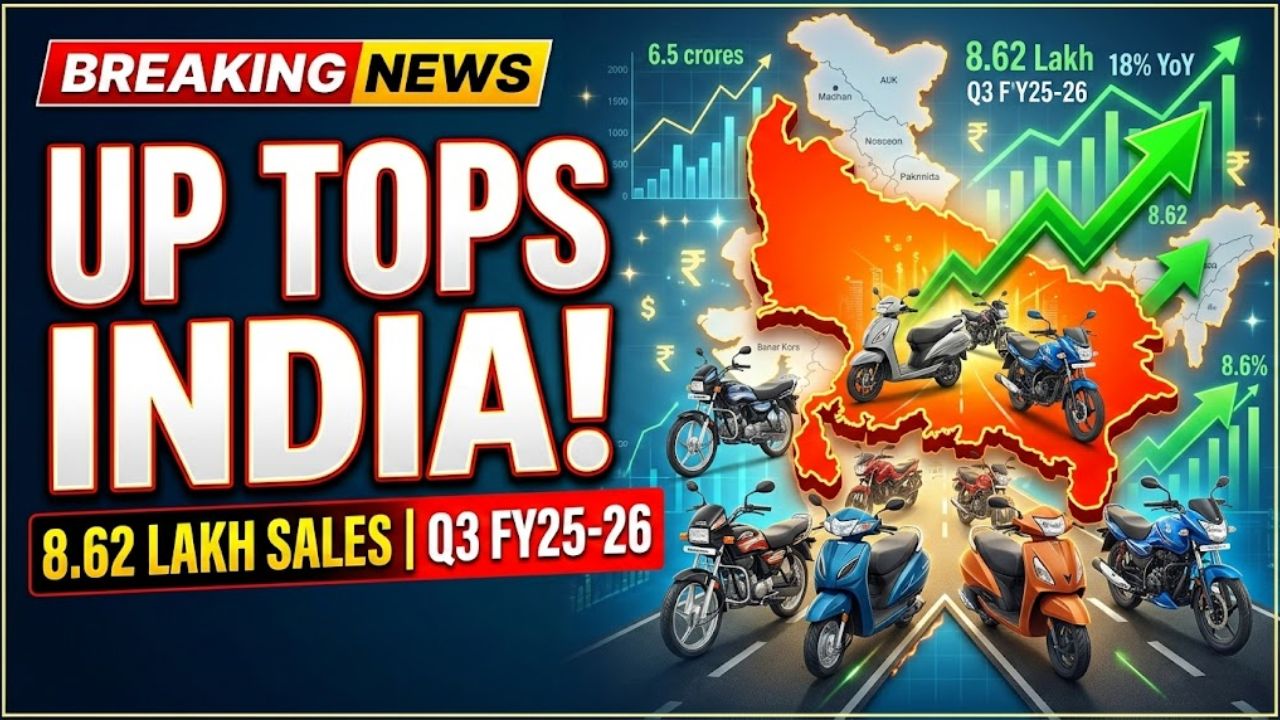
India two-wheeler sales Q3 FY2025-26 hit 56.96 lakh units, with Uttar Pradesh leading the charts. Here’s a clear breakdown of state-wise demand and regional trends. India sold a massive 56.96 lakh two-wheelers between October and December 2025, and the numbers clearly show how deeply rooted this segment is in rural and semi-urban markets. According to data released by the Society of Indian Automobile Manufacturers (SIAM), consumer registrations remained strong throughout the quarter. Notably, this period included the festive season tail-end, which traditionally boosts sales across categories.
Moreover, these figures represent actual retail registrations rather than wholesale dispatches, which makes the data more reliable for understanding real consumer demand. Therefore, the Q3 FY2025-26 numbers offer a clear snapshot of buying behavior across India.
Uttar Pradesh Leads State-Wise Two-Wheeler Sales
Uttar Pradesh dominated the charts with 8.62 lakh units, accounting for an impressive 15.1% share of total national sales. Clearly, the state relies heavily on two-wheelers as a primary mode of transportation. While large cities contribute steady volumes, rural and semi-urban regions drive a significant portion of demand. Meanwhile, Maharashtra secured the second position with an 11.3% share. Although it has several urban hubs like Mumbai and Pune, rural connectivity needs across the state also fuel strong commuter demand. Consequently, Maharashtra continues to remain a crucial market for manufacturers.
Southern and Western States Maintain Strong Presence
Tamil Nadu followed with an 8.0% share, and this performance reflects its strong manufacturing ecosystem and widespread dealer network. Additionally, the state benefits from consistent urban and semi-urban retail activity. Similarly, Gujarat contributed 7.4% of national sales. Because the state balances industrial growth with rural consumption, two-wheelers remain a practical mobility solution. Furthermore, states like Bihar and Karnataka each recorded a 6.0% share, highlighting how affordability and practicality drive purchases in emerging markets.
Interestingly, Rajasthan also matched the 6.0% mark. Meanwhile, Madhya Pradesh followed at 5.8%, and West Bengal contributed 4.5%. Therefore, the mid-tier states collectively created a tightly packed contribution band.
Emerging States and “Others” Category Contribution
Odisha, Haryana, Telangana, Andhra Pradesh, and Punjab each contributed between 2.9% and 3.3%. Although their individual shares appear modest, together they represent steady and dependable volumes. Additionally, Chhattisgarh accounted for 2.6% of total national sales.
Read Also: Vivo Launches New Budget Smartphone – Vivo Y05 Could Be the Best Affordable Choice of 2026
On the other hand, smaller states and union territories collectively formed the “Others” category, which held a substantial 11.9% share. Therefore, while large states dominate the headlines, demand remains meaningfully distributed across the country.
Western Zone Tops Regional Sales
At the regional level, the Western Zone led the country with 19.06 lakh units sold during the quarter. Because Maharashtra and Gujarat together account for nearly one-fifth of national demand, the region naturally secured the top spot.
Moreover, urban demand from cities like Mumbai, Pune, and Ahmedabad combines with strong rural consumption across their hinterlands. Consequently, the Western Zone continues to serve as a strategic focus area for manufacturers.
Why Two-Wheelers Remain India’s Mobility Backbone
India continues to hold its position as the world’s largest two-wheeler market by volume. While public transport infrastructure improves gradually, many consumers still prefer motorcycles and scooters for daily commuting. Additionally, rural areas depend heavily on two-wheelers due to limited connectivity options.
In addition, the segment supports last-mile delivery services and small business operations. Therefore, two-wheelers serve both personal and commercial mobility needs. Manufacturers have recognized this trend and increasingly focus on entry-level and mid-range models tailored to price-sensitive buyers.
Furthermore, financing schemes, exchange bonuses, and festive discounts during the October–December period encouraged higher retail conversions. As a result, states like Uttar Pradesh and Bihar showcased rising purchasing power in semi-urban and rural belts.
Retail Data vs Wholesale Dispatches: Why It Matters
SIAM publishes state-level retail registration data to ensure transparency in regional consumption trends. Unlike wholesale dispatch figures, retail data reflects actual purchases by end-users. Therefore, analysts consider these numbers more accurate indicators of market health.
Meanwhile, wholesale numbers often fluctuate due to production schedules and inventory adjustments. Consequently, retail registration data provides a clearer picture of genuine consumer sentiment.
| Region/State | Share (%) |
|---|---|
| Uttar Pradesh | 15.1% |
| Maharashtra | 11.3% |
| Tamil Nadu | 8.0% |
| Gujarat | 7.4% |
| Bihar & Karnataka | 6.0% each |
| Western Zone (Total) | 19.06 lakh units |
Overall, India’s two-wheeler market continues to demonstrate resilience and deep penetration across income segments. As rural prosperity improves and financing options expand, demand is likely to remain steady in upcoming quarters.
FAQs on India Two-Wheeler Sales Q3 FY2025-26
| FAQ | Answer |
|---|---|
| Which state recorded the highest two-wheeler sales in Q3 FY2025-26? | Uttar Pradesh led with 8.62 lakh units and a 15.1% share. |
| Why is retail data more important than wholesale data? | Retail data reflects actual consumer registrations, offering a clearer demand picture. |
| Which region topped overall sales? | The Western Zone led with 19.06 lakh units during the |