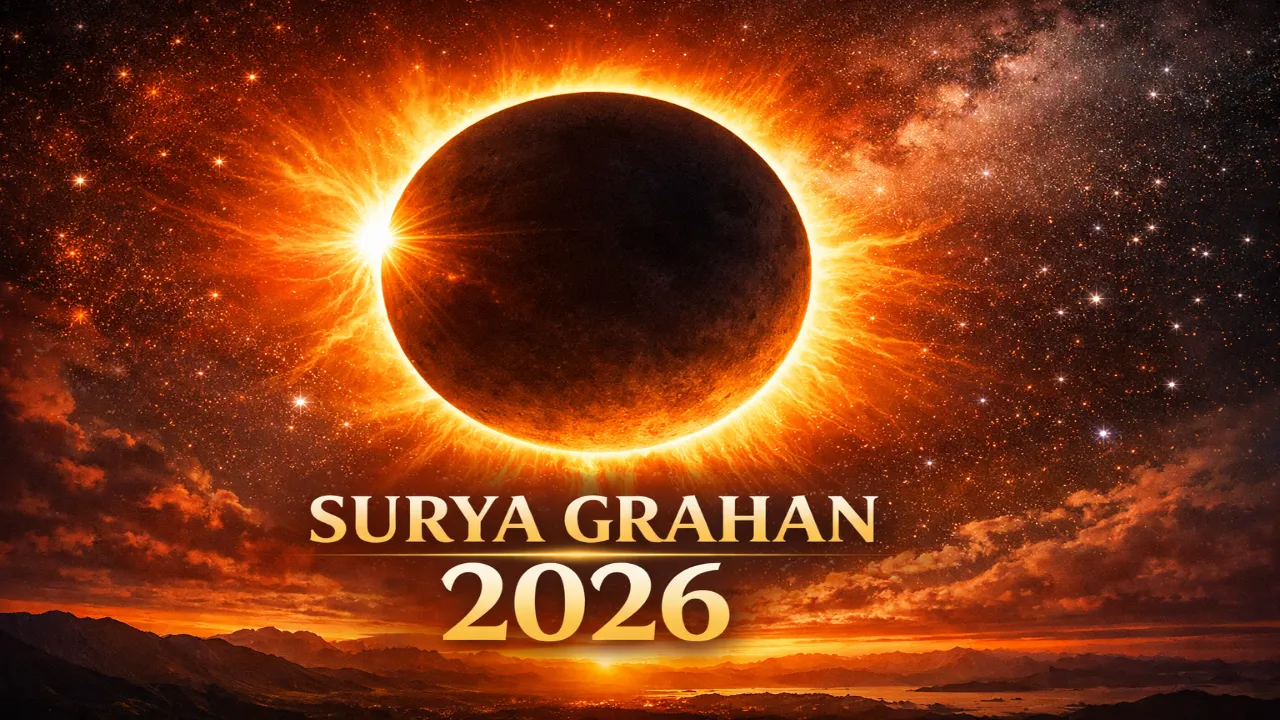
Surya Grahan 2026 in India: The first solar eclipse of 2026 occurs on 17 February. Know the exact date, time, Sutak Kaal rules, Ring of Fire effect, and visibility details.
Surya Grahan 2026 Date and Time in India
The first Surya Grahan 2026 will take place on 17 February 2026, coinciding with the Amavasya (new moon) of the Falgun month in the Hindu calendar. According to Indian Standard Time (IST), the solar eclipse will begin at 3:26 PM, reach its maximum at 5:42 PM, and end at 7:57 PM. Therefore, the total duration of the eclipse will be approximately 4 hours and 31 minutes. However, although the eclipse follows Indian timings, it will not be visible in India. Consequently, many traditional restrictions associated with the eclipse, including Sutak Kaal, will not be considered valid in most parts of the country.
Read More :- The Tech Bros May Show Humility in Delhi — But Will They Actually Make AI Safer?
What Type of Solar Eclipse is Surya Grahan 2026?
Astronomers confirm that this will be a ring-shaped or annular solar eclipse, commonly known as the “Ring of Fire.” During this celestial event, the Moon moves between the Earth and the Sun. However, because the Moon will be slightly farther from Earth at that time, it will appear smaller and will not completely cover the Sun. As a result, a bright outer ring of sunlight will remain visible around the Moon. This glowing circular outline creates the dramatic “Ring of Fire” effect. Moreover, annular eclipses are visually striking and scientifically significant because they demonstrate the dynamic distance variations between Earth and the Moon.
Read More :- Big Player’ Azmatullah Omarzai Has the Final Say for Afghanistan at T20 World Cup
Where Will the Solar Eclipse Be Visible?
Although Indian viewers will miss this celestial event, the eclipse will be visible in several parts of the Southern Hemisphere. It can be seen in Antarctica, Argentina, Chile, South Africa, Namibia, Botswana, Zimbabwe, Zambia, Tanzania, Madagascar, Mauritius, Mozambique, and several island regions including Réunion and the British Indian Ocean Territory. Therefore, skywatchers in these regions will witness the Ring of Fire phenomenon directly. Meanwhile, people in India can follow live streams provided by astronomical organizations and space agencies.
Read More :- We Know We Need To Be A Lot Better’ – England Reflect on Latest Narrow Escape in T20 World Cup 2026
Sutak Kaal: Is It Applicable in India?
In Hindu tradition, Sutak Kaal begins approximately 12 hours before a solar eclipse and is considered an inauspicious period. During this time, many people avoid religious rituals, cooking, eating, and touching idols in temples. Additionally, auspicious ceremonies are generally postponed. However, since the Surya Grahan 2026 will not be visible in India, Sutak Kaal will not be considered valid in most regions. Consequently, daily activities and religious practices can continue normally. Nevertheless, individuals who follow strict personal beliefs may still observe precautions voluntarily.
Rare Astrological Significance of Surya Grahan 2026
Astrologically, this eclipse holds special importance because it will occur in the zodiac sign Aquarius (Kumbh Rashi), which is ruled by Saturn (Shani). Moreover, on this day, a rare planetary alignment will form. The Sun, Moon, Rahu, Mercury, and Venus will align in Aquarius, creating a Panchgrahi Yog (five-planet conjunction). According to astrologers, such a combination occurs after nearly 37 years, with the last similar alignment recorded in 1989. Therefore, many astrology experts consider this eclipse highly significant from a spiritual and cosmic perspective. However, scientific communities emphasize the astronomical explanation rather than astrological interpretations.
Types of Solar Eclipses Explained
To better understand Surya Grahan 2026, it helps to know the three main types of solar eclipses:
| Type of Solar Eclipse | Description |
|---|---|
| Partial Solar Eclipse | The Moon covers only a portion of the Sun, leaving the rest visible. |
| Total Solar Eclipse | The Moon completely covers the Sun, causing temporary darkness during the day. |
| Annular Solar Eclipse | The Moon covers the center of the Sun but leaves a bright ring around it (Ring of Fire). |
Since the February 2026 event is annular, observers in visible regions will see a bright solar ring instead of complete darkness. Consequently, protective eyewear remains essential for safe viewing.
Scientific and Cultural Impact of Solar Eclipses
Scientifically, solar eclipses offer astronomers valuable research opportunities. For instance, researchers study the Sun’s corona, measure atmospheric changes, and analyze light variations. Moreover, such events inspire public interest in astronomy and space science. Culturally, eclipses hold deep meaning in India and many other countries. While some communities view them as spiritually significant, others approach them with curiosity and scientific enthusiasm. Therefore, Surya Grahan 2026 represents both a cosmic event and a cultural moment. In conclusion, although India will not witness the Ring of Fire directly, the first solar eclipse of 2026 remains globally significant. Whether viewed through science or tradition, this celestial event continues to captivate people around the world.
| FAQ | Answer |
|---|---|
| Will Surya Grahan 2026 be visible in India? | No, the annular solar eclipse will not be visible in India. |
| What is the time of the solar eclipse on 17 February 2026? | It starts at 3:26 PM IST and ends at 7:57 PM IST. |