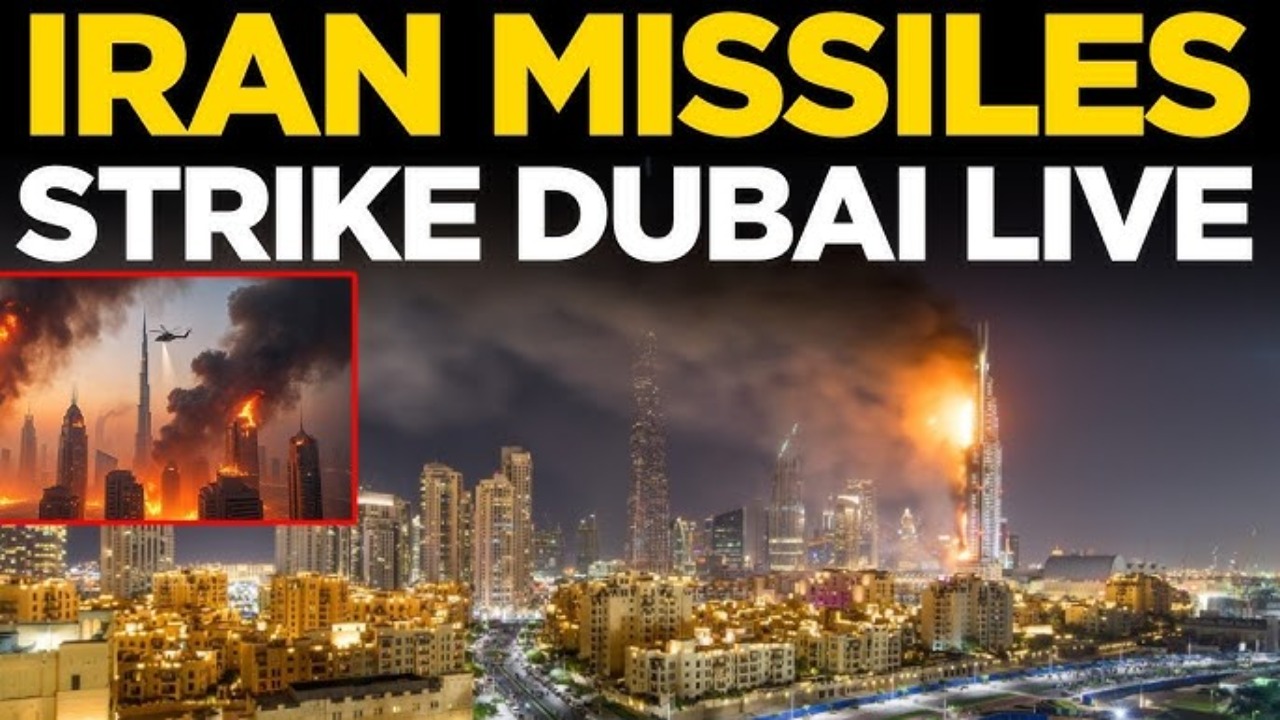
In an event that has stunned the entire world, Dubai one of the most globally recognized symbols of modern prosperity and security found itself under a cascading wave of Iranian drone and missile strikes on the night of February 28, 2026. What began as a distant geopolitical confrontation between the United States, Israel, and Iran rapidly transformed into a direct threat to millions of residents, tourists, and expatriates living across the UAE. The sounds of interceptions, blasts, and emergency sirens replaced the familiar hum of one of the busiest cities on Earth. This live developing story continues to evolve by the hour.
Dubai Drone Debris: 2 Injured as Debris Falls on Residential Houses
The most immediate human cost in Dubai came when drone debris fell directly onto the courtyards of two residential homes, injuring two people who were fortunately receiving prompt medical attention shortly after. Iranian missiles and intercepts sent debris over Abu Dhabi and the Palm Jumeirah area of Dubai, leading to multiple injuries and shutting down flights at Dubai’s main airports. While authorities were quick to manage the situation, the psychological impact on residents sheltering in their homes was immense, with many reporting they had no warning before the sound of explosions overhead.
What Caused This Crisis: Understanding the US-Israel Strike on Iran
To understand why Dubai became a target, one must look at the sequence of events that began hours earlier. The Israeli military said its strikes on Iran, carried out in coordination with the United States, targeted dozens of military sites and followed months of joint planning between the two allies. Iran had previously made it explicitly clear that any military attack on its soil would be met with sweeping retaliatory strikes against US military assets spread across Gulf nations — and on February 28, it followed through on that threat with an unprecedented wave of coordinated drone and missile launches targeting the entire region simultaneously.
Iran’s Retaliation Strategy: Every Gulf State in the Crossfire
Iran’s retaliation was not limited to a single country. Iran’s retaliation campaign included aiming ballistic missiles and drones at US bases and Israel spilling into neighboring Arab states that host American forces or sit under flight paths including the United Arab Emirates, Qatar, Kuwait, Bahrain, and Jordan. This broad targeting strategy reflected Tehran’s desire to demonstrate the full geographic reach of its military capabilities while signaling that any nation hosting US forces would bear the consequences of American military action against Iran.
UAE Air Defence Responds: 132 Missiles Destroyed, 195 Drones Intercepted
The UAE’s air defence systems performed at extraordinary capacity throughout the night. The UAE Ministry of Defence says its air defences destroyed 132 missiles launched toward the country and intercepted 195 Iranian drones during the recent barrage of attacks. Despite this impressive operational response, the sheer volume and frequency of incoming projectiles meant that debris from intercepted missiles and drones inevitably scattered across populated areas of Dubai and Abu Dhabi, causing fires, injuries, and widespread panic among a civilian population entirely unaccustomed to such a rapid and overwhelming threat from the skies.
Burj Al Arab on Fire: Dubai’s Most Iconic Hotel Targeted
Among the most visually shocking developments of the entire night was the sight of flames on the Burj Al Arab, the sail-shaped luxury hotel that has served as Dubai’s defining global image for over two decades. Debris from an intercepted drone struck the Burj Al Arab on Saturday night, igniting a fire on the outer facade of Dubai’s most iconic hotel as Iranian retaliatory strikes continued to batter the UAE. Authorities responded and brought the blaze under control. No injuries were reported at the property. Videos of the fire spread instantly across global social media, becoming one of the defining and most disturbing images of the entire crisis.
Palm Jumeirah Explosion: Fairmont Hotel Hit, 4 People Injured
Minutes before the Burj Al Arab incident, Dubai’s Palm Jumeirah the man-made island synonymous with ultra-luxury living was rocked by a direct strike. An Iranian Shahed drone caused a large explosion and fire at Fairmont The Palm on Palm Jumeirah. The Dubai Media Office confirmed an “incident” in a building in the Palm Jumeirah area that resulted in a fire and four people injured. The Palm Jumeirah is home to thousands of permanent residents, tourists, and high-net-worth individuals from around the world, making this one of the most consequential civilian incidents of the entire night’s events.
Dubai International Airport Hit: Four Staff Injured, Flights Halted Indefinitely
The crisis reached its most globally disruptive point when Dubai International Airport regularly ranked as the world’s busiest airport for international passengers sustained damage and was forced to suspend all operations. “Dubai Airports confirms that a concourse at Dubai International (DXB) sustained minor damage in an incident, which was quickly contained. Four staff sustained injuries and received prompt medical attention. Due to contingency plans already in place, most of the terminals were previously cleared of passengers,” the Dubai Media Office confirmed. The closure sent immediate shockwaves through global aviation networks, with thousands of connecting flights disrupted worldwide.
Jebel Ali Port Fire: Strategic Military-Commercial Hub Struck
The Jebel Ali Port a facility that is simultaneously Dubai’s most important commercial gateway and a regular port of call for US Navy warships was also caught in the night’s devastating events. One of the berths at Dubai’s Jebel Ali Port caught fire because of debris resulting from an aerial interception. Jebel Ali is the largest port in the Middle East and one of the top ten busiest container ports in the world. Any damage to or disruption at this facility carries enormous implications for regional trade, global supply chains, and US military logistics across the entire Gulf region.
Abu Dhabi Tragedy: One Killed, Seven Injured at Zayed International Airport
While Dubai dominated international headlines, Abu Dhabi suffered the single most tragic incident of the entire episode. Authorities in Abu Dhabi reported an interception of a drone that targeted Zayed International Airport, killing an Asian national and leaving seven injured. Loud booms were heard across Abu Dhabi, and smoke billowed from a point offshore opposite the city. Some residents received a phone alert telling them to shelter in the closest secure building and stay away from windows because of missile threats. This single fatality became the most deeply human reminder of the real cost of geopolitical conflict playing out above a civilian city.
Qatar Under Attack: Missiles and Drones Near Al Udeid Air Base
Qatar home to Al Udeid Air Base, the largest US military installation in the entire Middle East — was among the most strategically significant targets in Iran’s sweeping retaliation plan. In Qatar, dozens of people fled in panic as a falling missile plunged into a residential neighbourhood, erupting in a fireball as it hit the street. Qatar’s Defence Ministry said it “thwarted” attacks on the country in accordance with a “pre-approved security plan”, intercepting “all missiles” before they reached the country’s territory. Despite the military’s operational success, the psychological impact on ordinary Qatari residents was severe and will take considerable time to heal.
Qatar’s Official Condemnation: Sovereignty Violated
Qatar’s government responded with unusually sharp diplomatic language, reflecting its fury at being targeted by a regional neighbour with which it maintains no direct military conflict. The Qatari Foreign Ministry said that the targeting of Qatar by a neighbour “cannot be accepted under any justification or pretext”, pointing out that it had always distanced itself from regional conflicts. Qatar has long positioned itself as a neutral regional mediator, simultaneously hosting Hamas political leadership, maintaining working ties with Iran, and housing tens of thousands of US troops a balancing act that has now been violently disrupted by the events of February 28.
Iran’s IRGC Declares War on All US Assets in the Region
Iran’s military made its intentions unmistakably clear through official statements released throughout the day. Iran’s Islamic Revolutionary Guard Corps (IRGC) claimed all Israeli and US military targets in the Middle East have been struck “by the powerful blows of Iranian missiles”, declaring: “This operation will continue relentlessly until the enemy is decisively defeated.” All US assets throughout the region are considered legitimate targets for Iran’s army. This sweeping declaration effectively transforms every Gulf state hosting a US base, vessel, or military personnel into a potential future target a reality that has sent governments, businesses, and expatriate communities scrambling to urgently reassess their positions and contingency plans.
Travel Chaos: Over 14,000 Flights Disrupted Globally
The human impact of the airspace closures extended far beyond the Gulf region itself, disrupting lives and travel plans on every continent. Airlines were forced to cancel thousands of flights to Middle East destinations including Tel Aviv, Doha, and Dubai after airspace was closed following the attacks. At least 14,000 departure and arrival flights have been affected, according to estimates. Etihad Airways suspended all flights departing or flying into Abu Dhabi until Sunday. Passengers stranded across Europe, Asia, and the Americas found themselves unable to reach their destinations, while those already inside the Gulf faced the terrifying prospect of being unable to leave a region suddenly engulfed in open military conflict.
Safety Guide: What Gulf Residents Must Do Right Now
If you are currently living in or visiting any Gulf state, the single most important step is to stay informed through official government channels only and avoid unverified social media entirely. Register immediately with your home country’s embassy for emergency evacuation notifications and keep your passport and essential documents within easy reach at all times. If you hear explosions or air raid sirens, move away from all windows immediately and shelter in the lowest, most interior part of your building. Do not travel to any airport without first verifying the official operational status of your specific flight, as most regional airports currently remain closed with no confirmed reopening timeline.
Conclusion: Dubai’s Image Shaken, the Gulf’s Future Uncertain
What unfolded on February 28, 2026 was far more than a military confrontation between nations — it was a direct and violent challenge to the foundational identity of modern Dubai and the broader Gulf region as a safe, stable, and globally integrated hub for commerce, tourism, finance, and expatriate life. Iran launched an unprecedented wave of airstrikes in the region targeting US bases and fracturing the emirate’s long-held image of a haven in a tough neighborhood. Dubai has prided itself on its unshakable security and safety. The speed with which that carefully cultivated image was shattered in a single night will have consequences economic, diplomatic, reputational, and deeply personal that will take years, not months, to fully understand and recover from. The entire world is watching the Gulf as never before.